Electric Propulsion · VLEO · Krypton

Accelerating
your mission

We are building AI-optimised Hall Effect Thrusters that extend satellite lifetime and enable continuous drag compensation in Very Low Earth Orbit — without relying on US-export-controlled components.
Our Technology Get in Touch
27%
Simulated reduction in wall erosion flux
1.38×
Simulated lifetime multiplier vs baseline
ITAR-free
Fully European supply chain — no US export controls
TRL 2–3
Simulation validated — hardware development in progress
Technology

Designed from first principles for VLEO

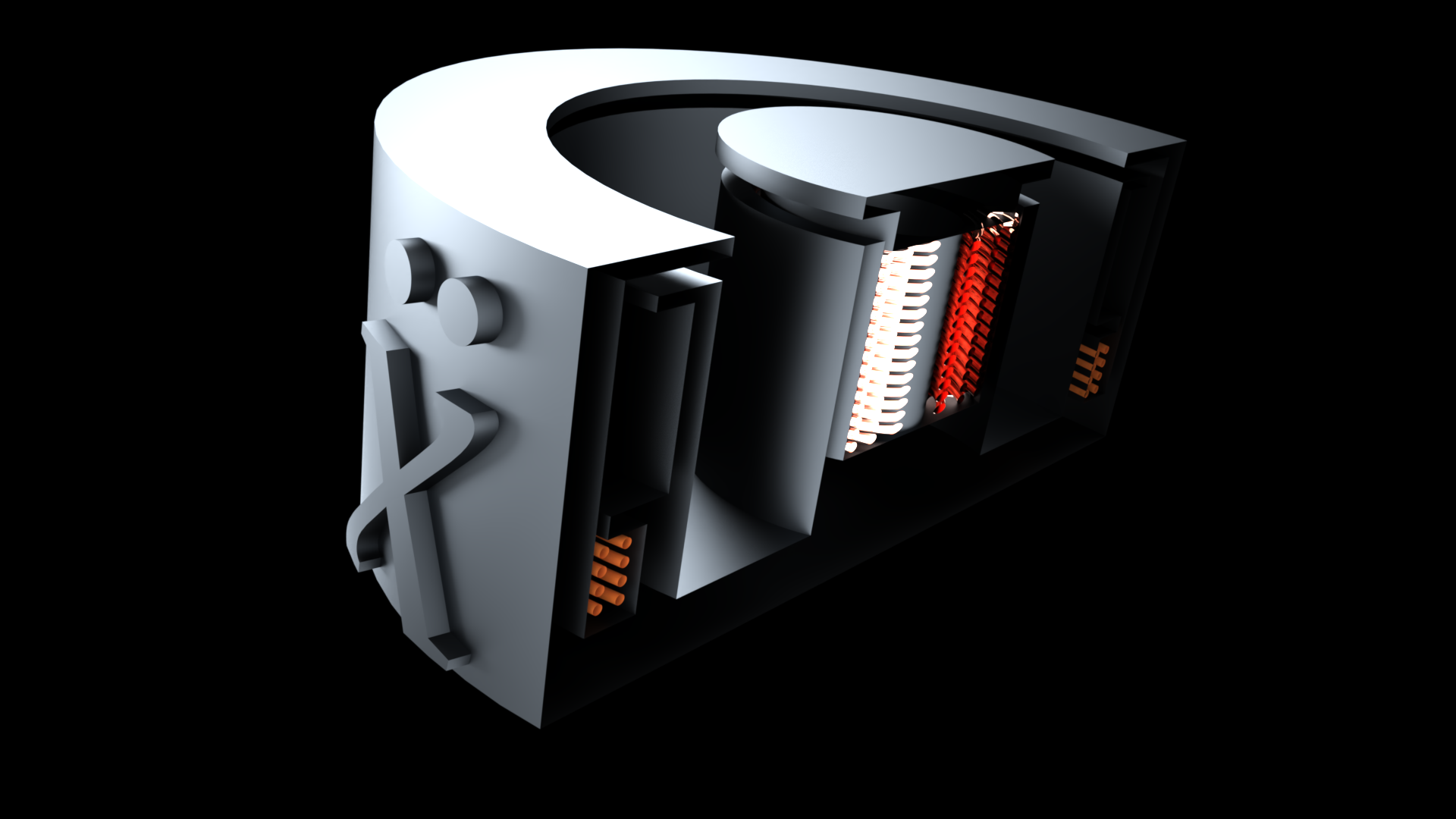
Hall Effect Thrusters have proven themselves in GEO and MEO. The frontier is VLEO — altitudes below 450 km where atmospheric drag is significant and thruster lifetime is the limiting factor. We've built a propulsion stack around solving that problem.

Aegis — AI Magnetic Optimisation

Our core software, Aegis, uses reinforcement learning to optimise the thruster's magnetic field topology. It minimises erosive ion flux to the channel walls, extending operational lifetime. Simulations show a 27% reduction in wall erosion flux and a 1.38× lifetime multiplier over the unoptimised baseline.

🔵

Krypton-Native Architecture

We design around Krypton from day one. Kr offers higher specific impulse per unit cost than Xenon, is abundant in European supply chains, and is not subject to the same geopolitical supply risks. Our magnetic field profiles and channel geometry are co-optimised for Kr's ionisation physics.

🛡️

Magnetically Shielded Pole Geometry

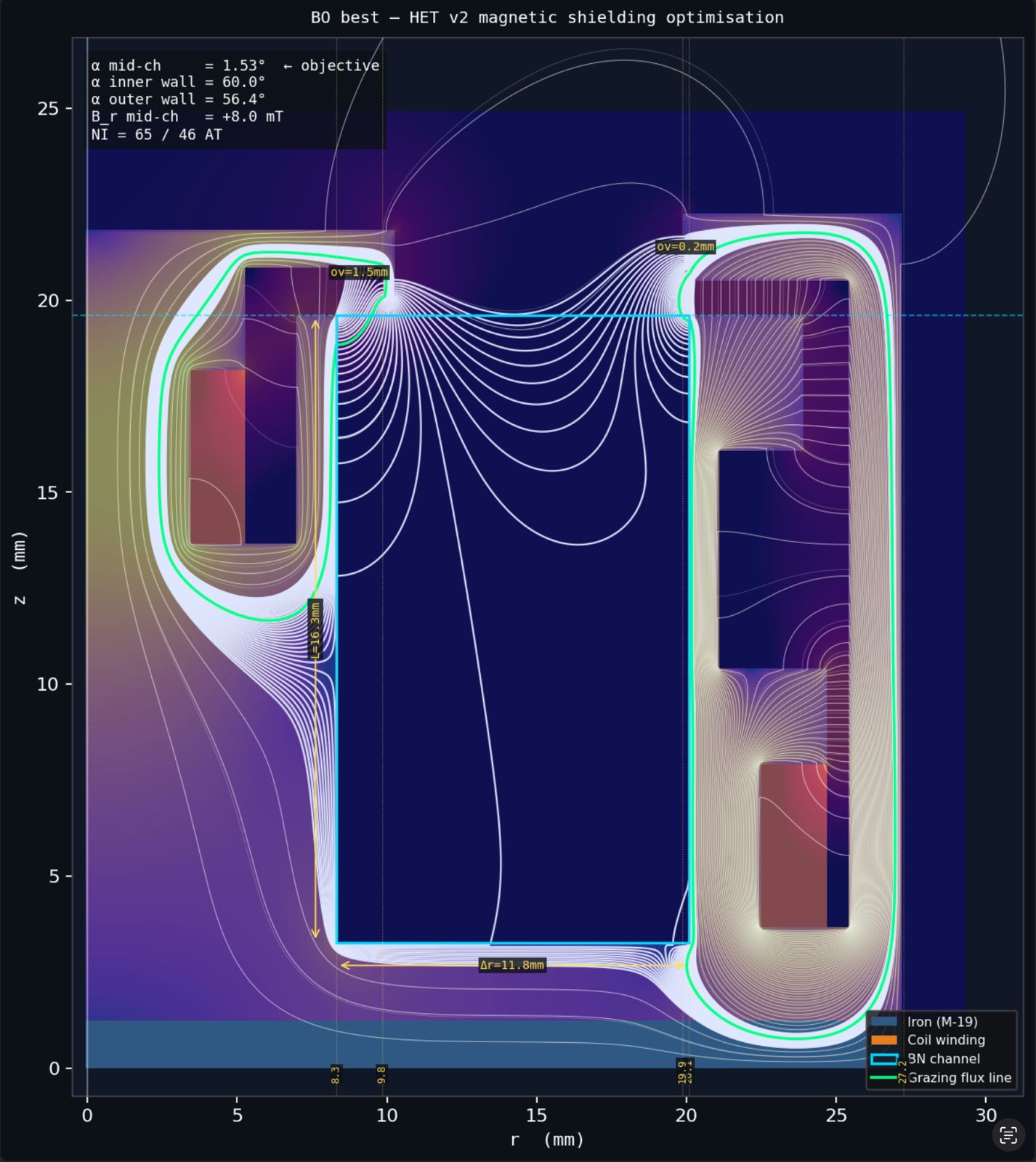
We apply flux-surface-matched pole piece geometry (following Mikellides 2014) to shape the magnetic field so that equipotential surfaces run parallel to the channel walls. This near-eliminates the radial electric field component responsible for wall bombardment — the dominant wear mechanism in conventional thrusters.

🌍

ITAR-Free by Design

Every component — from the discharge chamber to the power processing unit — is specified for European manufacture. No reliance on US-controlled technology means our customers can integrate without export licence delays, and European operators maintain full supply chain sovereignty.

The magnetic brain
of the thruster

In a Hall thruster, the shape of the magnetic field is everything. Too flat and it cuts straight through the plasma into the channel walls — ions bombard the ceramic and your thruster wears out in months. Shape it right and the field lines run almost perfectly parallel to those walls, dramatically reducing the erosion.

Aegis runs three electromagnet coils through a reinforcement learning controller, continuously holding that optimal field topology during flight. Not a lookup table, not a fixed operating point — an agent that actively responds to changing plasma conditions, temperature drift, and mission phase. The graphic shows the field line geometry it's maintaining.

Field lines run parallel to channel walls — near-zero wall ion flux
Runs autonomously on-board — no ground commands needed
Balances lifetime, thrust, and power draw simultaneously
RL agent trained on a validated 2D finite-difference physics model
Product

A complete propulsion system —
HET + PPU, fully integrated

Most thruster vendors sell you a thruster head and leave the PPU to someone else. We ship the full electric propulsion system: 200 W Krypton Hall thruster, power processing unit, and Aegis flight software — qualified together, integrated, ready to bolt on.

In Development

The system is in the simulation and detailed design phase. Physics models have been validated against published experimental data and independent simulation frameworks. Hardware development is in progress.

Thruster (HET)
Propellant
Krypton (Kr)
Power level
200 W nominal
Discharge channel
BN ceramic, 36 mm mean diameter
Magnetic shielding
Aegis flux-surface matched poles
Power Processing Unit
Discharge supply
250 V, current-regulated
Coil drivers
3-channel, ±5 A, Aegis-controlled
Controller
STM32, runs Aegis flight software
System
Export classification
ITAR-free · EAR99 target
Current TRL
TRL 2–3 (simulation validated)
Phase 1 — Complete
Physics modelling & validation
2D finite-difference magnetic solver, reinforcement learning environment, and validation against published HET data and independent simulation frameworks.
Phase 2 — Complete
Aegis optimisation
Flux-surface matched pole geometry finalised. Aegis RL agent trained and evaluated. Magnetic shielding configuration selected.
Phase 3 — Active
Detailed hardware design
Pole piece geometry, BN channel, PPU schematic, hollow cathode integration, and propellant feed system specification.
Phase 4
Bench hardware & vacuum testing
First article manufacture, vacuum facility testing, performance and lifetime characterisation.
Phase 5
Flight qualification
Environmental testing, qualification campaign, and first flight opportunity.
Team

Built by engineers who care about the mission

We're a focused technical team combining expertise in spacecraft systems engineering and computational physics, united by the goal of making European in-space propulsion genuinely competitive.

Max Simmonds
Max Simmonds
Co-founder · Hardware & Software
Electrical and software engineer. Responsible for PPU design, Aegis RL architecture, simulation stack, and overall system integration.
Tizian
Tiziano Fiore
Co-founder · Physics & Propulsion
Propulsion physicist and thruster design lead. Responsible for magnetic circuit design, plasma physics modelling, channel geometry, and experimental validation strategy.
Contact

Work with us

We're looking for early partners — satellite operators, investors, and research collaborators who believe the next decade of space belongs to intelligent, sovereign propulsion. Get in touch.

maxsimmonds1337@gmail.com